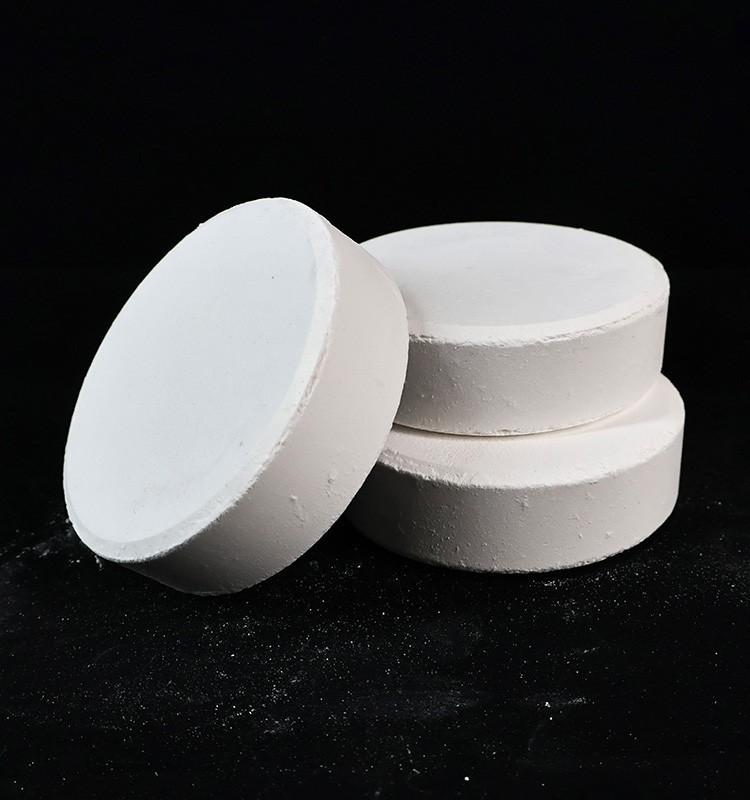
With the rise in public health awareness, disinfectants are increasingly applied in swimming pools, drinking water treatment, public facilities, medical settings, and other areas. Among these, trichloroisocyanuric acid (TCCA or TCCA tablets) has become a commonly used disinfectant due to its effective bactericidal properties, stable chlorine release, and ease of use. However, questions have been raised regarding its safety for human use: Are trichloroisocyanuric acid disinfectant tablets harmful to humans? This article will conduct an in-depth analysis from multiple perspectives, including chemical properties, safety risks, and usage guidelines.
Trichloroisocyanuric acid has the chemical formula C₃Cl₃N₃O₃. It is a chlorinated organic nitrogen compound structurally classified as a trichlorinated derivative of isocyanuric acid. Typically appearing as a white powder or tablet with a chlorine odor, it remains stable in solid form at room temperature.
Trichloroisocyanuric acid undergoes hydrolysis in water, producing hypochlorous acid (HOCl) and cyanuric acid (C₃N₃O₃H₃), thereby exerting its disinfectant effect. It also functions as a strong oxidizing agent with the potential to decompose and release chlorine gas under certain conditions.
Its physicochemical properties include: a melting point of approximately 246–247 °C (decomposes at higher temperatures), with a tendency to generate toxic gases at elevated temperatures; low solubility in water (approximately 1.2 g/100 mL at 25 °C).
Trichloroisocyanuric acid is widely used in the following fields:
- Swimming pool and bath disinfection: As tablets or a slow-release chlorine source to maintain water quality and provide stable disinfection.
- Drinking water or public sanitation water treatment: Used as a disinfectant under certain low-concentration conditions.
- Industrial wastewater and circulating water disinfection: Employed for sterilization in circulating cooling water and industrial plant water systems.
- Agriculture, forestry, animal husbandry, and food processing: Used to disinfect facilities, water bodies, and equipment surfaces.
- Bleaching agent and organic synthesis reagent: Also applied in textiles, papermaking, and chemical synthesis.
Evidently, trichloroisocyanuric acid is a highly effective and widely adopted chemical within the disinfection sector.
Despite its extensive applications, TCCA is not entirely harmless. Its safety risks primarily stem from the following aspects:
- Eye Damage: TCCA strongly irritates the eyes and may cause severe ocular injury or burns.
- Skin irritation: May cause mild to moderate skin irritation; contact with high concentrations or solutions can result in burns. Respiratory - Irritation: Inhalation of TCCA dust, mist, or chlorine gas may cause respiratory tract irritation, coughing, and breathing difficulties, potentially leading to pulmonary edema in severe cases.
- Ingestion Risk: Accidental ingestion of TCCA may cause gastrointestinal burns, bleeding, etc.
According to its Safety Data Sheet, TCCA is classified as hazardous for oxidizing properties, skin corrosion/irritation, serious eye damage, inhalation toxicity, oral toxicity, and high toxicity to aquatic life.
When TCCA contacts water, especially at high concentrations or in poorly ventilated areas, it may release chlorine gas (Cl₂). Chlorine gas is a highly irritating substance that damages the lungs, potentially causing acute respiratory injury or poisoning.
Recent studies indicate that skin contact with TCCA-containing water followed by UV exposure may amplify the inflammatory response to UV radiation. Specifically, the combined action of TCCA and solar UV radiation may exacerbate oxidative stress and inflammatory gene expression in the skin.
- Environmental Toxicity: TCCA is extremely toxic to aquatic organisms. Environmental release may cause damage to fish populations and aquatic ecosystems.
- Accumulation Concerns: In closed systems like swimming pools, cyanuric acid (a hydrolysis product of TCCA) accumulates in water, potentially impairing disinfection efficacy and disrupting water chemistry balance.
In summary, while risks are manageable within proper concentration ranges, TCCA does pose potential hazards to human health and the environment.
A 2022 study found that in mouse models, skin exposure to TCCA followed by ultraviolet radiation significantly amplified the gene expression of inflammatory responses. This suggests TCCA may exacerbate UV-induced skin damage during swimming or sun exposure.
The study noted that while TCCA is commonly used as a water disinfectant, its role as a precursor to HOCl may confer “chlorination stress” during skin exposure. This finding introduces new considerations regarding TCCA's dermal safety.
Literature reports indicate that inhaling chlorine gas may trigger severe complications such as pulmonary edema and mediastinal gas. Particularly in swimming pool environments or ind
ustrial accidents, chlorine gas leaks can cause acute respiratory damage.
The article notes that symptoms following chlorine inhalation may appear hours later, emphasizing the need for prompt medical monitoring after exposure to chlorinated substances.
Multiple Safety Data Sheets (SDS/MSDS) classify TCCA under hazard categories including “Severe Eye Damage,” “Skin Irritation,” “Harmful if Swallowed,” “Harmful if Inhaled,” and “Highly Toxic to Aquatic Life.”
For example, Parchem's MSDS states: TCCA can cause skin burns, severe eye damage, and is potentially fatal if inhaled. These documents collectively demonstrate that while TCCA possesses effective disinfection capabilities, its hazards cannot be overlooked.
To minimize potential risks to human health and the environment, adhere to the following safety protocols during application:
When used in swimming pools or drinking water, strictly follow national or industry standards (e.g., chlorine concentration limits, pH ranges for pool water) to regulate TCCA dosage.
Avoid overuse and never mix with other chemicals (such as acids or ammonium salts) to prevent unintended chemical reactions.
Dissolve, add, and handle TCCA in well-ventilated areas to prevent dust accumulation.
Operators must wear protective eyewear, gloves, protective clothing, and masks (dust masks or respirators).
TCCA is a strong oxidizing agent and must not be mixed with organic substances, ammonia compounds, strong acids, combustible materials, or reducing agents to prevent violent reactions, toxic gas generation, or explosions.
Employ slow-release dispensers, dosing systems, or specialized distribution equipment to ensure uniform dissolution and gradual release of TCCA, preventing localized overconcentration. Regularly monitor residual chlorine, pH levels, organic content, and other parameters to guarantee disinfection efficacy and safety. Periodically replace cyanuric acid and impurities in the water to prevent cumulative effects on water quality.
If accidentally contacted with skin or eyes, immediately rinse with copious amounts of water for at least 15 minutes and seek medical attention. If dust or chlorine gas is inhaled, quickly move to fresh air; those experiencing breathing difficulties should receive medical treatment.
- Select certified products that comply with national or industry standards
- Strictly adhere to dosage instructions in the manual; do not arbitrarily increase quantities
- Ensure well-ventilated operating environments and wear appropriate protective gear
- Regularly monitor water quality parameters such as residual chlorine and pH levels
- Immediately cease use and seek medical attention if discomfort occurs (e.g., eye irritation, respiratory distress)
Looking ahead, as environmental regulations tighten and public health awareness grows, the application and management of trichloroisocyanuric acid disinfection tablets may evolve in the following directions:
(1) Safer sustained-release formulations and dose control technologies
(2) Upgrades to low-chlorine/low-byproduct disinfection techniques
(3) Enhanced safety through online monitoring and automated control systems
(4) In-depth research on the effects of long-term low-concentration exposure to humans
In summary, under conditions of standard concentration compliance, proper operation, and sound management, trichloroisocyanuric acid disinfection tablets pose minimal risk to human health and play a vital role in water treatment and public health disinfection. However, they are not entirely risk-free. Attention should be paid to their irritating effects on skin, eyes, and respiratory tract; poisoning risks associated with chlorine gas release; synergistic effects with ultraviolet light; and environmental toxicity.

 E-mail:jcl@jichanglong.com
 WhatsApp:+8618560709619
 Address:Block B, Polymer Materials Industry Innovation Park,No. 51, Lutai Avenue, High-tech Zone, Zibo City, Shandong Province
Our company specializes in vanadium inhibitors , dehumidification and drying block, calcium hypochlorite disinfectant tablet, polyacrylamide and other products. With over 20 years of experience, we offer quality assurance and wholesale prices.


