With the development of public health, industrial water treatment, swimming pool management, and aquaculture, the use of disinfection products has become increasingly widespread in both daily life and industrial production. To control bacteria, viruses, algae, and other microorganisms in water bodies and environments, appropriate disinfectants are selected based on specific usage scenarios. Trichloroisocyanuric acid (TCCA) disinfection tablets are a common type of chlorine-based disinfectant.
Simply put, TCCA disinfection tablets are products that release "available chlorine" into water, making them suitable for disinfecting various water bodies and environments. Characterized by high chlorine content, ease of storage and transport, and simple application methods, they are valuable in sectors such as swimming pools, industrial circulating water systems, public environments, and aquaculture. However, as TCCA is an oxidizing chemical, it must be used in strict accordance with product labels, local regulations, and the manufacturer's technical specifications. Products with different concentrations and specifications are suited to different applications.
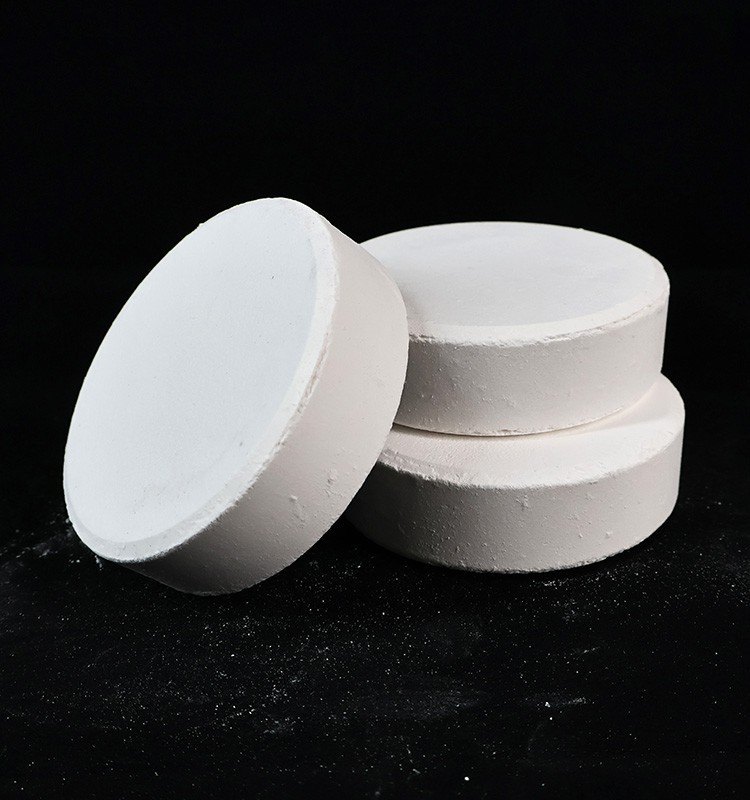
Trichloroisocyanuric acid is a chlorine-based disinfectant, commonly abbreviated as TCCA. It can be processed into various forms, such as tablets or granules. Disinfection tablets, in particular, are used in certain water treatment scenarios due to their compact size and ease of storage and transport.
When TCCA enters the water, it gradually releases available chlorine, which acts as a disinfectant. This available chlorine oxidizes and destroys key structural components of microorganisms, thereby reducing their population in the water. Thus, the primary function of TCCA disinfection tablets is to utilize available chlorine for disinfection and the inhibition of microbial growth.
Upon contact with water, TCCA disinfection tablets gradually dissolve and release available chlorine. Available chlorine possesses strong oxidizing capabilities, allowing it to target the cellular structures and key components of microorganisms, thereby disrupting their normal physiological activities.
This mechanism enables TCCA to control a wide range of microorganisms, including bacteria, viruses, fungi, and algae. The actual disinfection efficacy is influenced by factors such as water temperature, pH value, contact time, organic matter content, and overall water quality. Therefore, in practical applications, one cannot simply assume that adding disinfection tablets will invariably achieve the same disinfection results; instead, monitoring and control measures should be implemented based on the specific usage environment.
Swimming pool disinfection is one of the most common applications for TCCA disinfection tablets. Pool water is constantly exposed to human skin, sweat, and other organic matter; without proper disinfection management, microbial levels in the water can rise. Consequently, swimming pools typically require a continuous water quality management system comprising filtration, circulation, disinfection, and water quality monitoring. TCCA disinfection tablets serve as a chlorine-based disinfectant option to help control microorganisms and algae in the water.
When using them, it is crucial to determine the appropriate dosage based on the pool's water volume and the product label, and to regularly monitor water quality indicators such as residual chlorine and pH levels. Simply increasing the dosage of the disinfectant is not a solution for all water quality issues.
In certain industrial water treatment systems, microbial proliferation can lead to biofilm formation, unpleasant odors, and other operational issues. For instance, some circulating cooling water systems operate in warm, humid environments that foster microbial growth. Provided system requirements are met, TCCA can be used as a chlorine-based biocide to help control microorganisms in the water.
However, the selection of a disinfection strategy for industrial circulating water systems usually depends on water quality, equipment materials, and process conditions. Metal equipment, in particular, is susceptible to corrosion caused by chlorine-based agents; therefore, dosage should not be increased arbitrarily without prior assessment.
Chlorine-based disinfection products may also be used for facility or water management in certain aquaculture operations. TCCA possesses strong oxidative disinfection capabilities and can be used to disinfect environments and facilities in specific scenarios. However, aquaculture environments involve aquatic life—such as fish and shrimp—that are highly sensitive to disinfectant concentrations. Therefore, the selection and use of these products must strictly adhere to their intended scope of application, label requirements, and professional technical protocols. It is particularly important to avoid using products intended for general environmental disinfection in aquaculture settings where strict limits on disinfectant concentrations apply.
Some TCCA products can also be used to disinfect specific public environments and facilities. For instance, provided that product label and regulatory requirements are met, they may be used on surfaces such as floors, walls, public facilities, and tools, as well as on non-food-contact surfaces. Since available chlorine content and approved uses vary by product, one must verify that the product label permits use in the intended environment before application.
This is particularly important for scenarios involving direct contact with food, drinking water, or the human body; in such cases, products with the appropriate intended uses and certifications must be used.
Compared to some liquid disinfectants, the tablet form offers specific advantages regarding use and storage:
(1) Ease of storage (solid form): Tablets are generally easier to package and transport than liquid products.
(2) High available chlorine content: TCCA has a high available chlorine content, providing strong disinfection capabilities.
(3) Convenience of use: Provided label requirements are met, dosages can be precisely adjusted based on water volume and the intended application.
(4) Wide range of applications: Depending on product specifications and approved uses, they can be utilized in water treatment, swimming pools, and environmental disinfection.
(5) Sustained action: TCCA gradually releases available chlorine in water, thereby providing a degree of sustained disinfection.
TCCA is an oxidizing, chlorine-containing chemical; therefore, safety precautions are essential during use. First, TCCA must not be mixed with acidic cleaners, ammonia-based products, or other incompatible chemicals, as this could trigger dangerous chemical reactions. Second, the product should be stored according to label instructions, keeping the packaging sealed, dry, and intact. Direct contact with skin and eyes must be avoided, and appropriate personal protective equipment (PPE) should be worn during handling. Furthermore, different applications require specific product formulations; when using the product for swimming pools, industrial water treatment, environmental disinfection, or other specialized scenarios, one must verify that the label explicitly permits the intended use.
Both trichloroisocyanuric acid (TCCA) and hypochlorite-based bleaching products release available chlorine, yet they differ in chemical composition and usage characteristics. TCCA belongs to the class of chlorinated isocyanuric acid disinfectants and typically comes in the form of solid tablets or granules.
In contrast, common bleaching agents usually exist as aqueous hypochlorite solutions. Consequently, the two differ in terms of available chlorine concentration, storage requirements, stability, and suitable applications. The choice of product should be determined by the specific water treatment system, the target of disinfection, and the requirements listed on the product label; one cannot simply assume a single product is suitable for every scenario.
When purchasing TCCA disinfection tablets, pay attention to the product's basic technical specifications. First, check the available chlorine content, as levels can vary between products. Second, verify the intended use; for instance, requirements for swimming pool disinfection differ from those for general environmental disinfection. Third, consider the dissolution rate and tablet specifications, as different equipment and water conditions may require specific product types. Additionally, review the quality certifications, usage instructions, and safety information provided by the manufacturer. For industrial clients, it is advisable to conduct tests based on actual water quality and equipment conditions before finalizing a long-term usage plan.
TCCA disinfection tablets are a common chlorine-based disinfectant that controls bacteria, viruses, fungi, and algae in water and environments primarily by releasing available chlorine. Depending on specifications and intended use, they can be applied to swimming pool water disinfection, certain industrial water treatment processes, specific aquaculture facilities and water management, and the disinfection of various environments and facilities. While TCCA tablets offer advantages such as convenient solid-state storage, high available chlorine content, and ease of use, they are not ordinary cleaning products to be used indiscriminately. In practice, operations must strictly adhere to product labels, manufacturer technical specifications, and local regulations, with usage conditions adjusted according to water quality and the specific disinfection target.
For enterprises requiring long-term use of TCCA disinfection tablets, establishing a sound system for water quality monitoring and disinfection management is far more important than simply increasing the dosage. By selecting the right product and scientifically controlling usage conditions, one can maximize the disinfectant efficacy of TCCA tablets while minimizing safety and equipment risks associated with improper use.

 E-mail:jcl@jichanglong.com
 WhatsApp:+8618560709619
 Address:Block B, Polymer Materials Industry Innovation Park,No. 51, Lutai Avenue, High-tech Zone, Zibo City, Shandong Province
Our company specializes in vanadium inhibitors , dehumidification and drying block, calcium hypochlorite disinfectant tablet, polyacrylamide and other products. With over 20 years of experience, we offer quality assurance and wholesale prices.


