Calcium hypochlorite disinfection tablets play a vital role in sterilization and disinfection across multiple fields, including public health epidemic prevention, drinking water purification, swimming pool disinfection, and industrial wastewater treatment. As a highly effective oxidizing disinfectant, it rapidly releases highly reactive chlorine with strong oxidizing properties, effectively eliminating microorganisms such as bacteria, viruses, fungi, and algae.
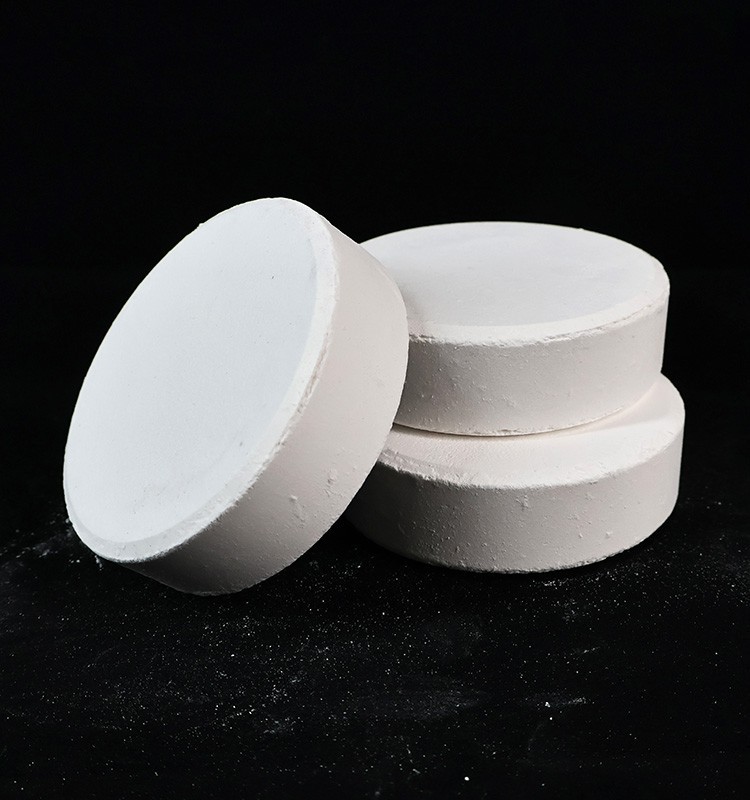
Calcium hypochlorite (chemical formula Ca(ClO)₂) is a white or grayish-white granular solid with a strong chlorine odor. Highly soluble in water, it is a common industrial-grade, highly effective chlorine-based disinfectant.
Originally used for drinking water sterilization and fabric bleaching, it has since found widespread application in environmental disinfection, food processing, aquaculture, swimming pools, and wastewater treatment. Calcium hypochlorite is a strongly oxidizing inorganic salt that reacts with water to form hypochlorous acid (HClO) and release active chlorine, thereby achieving disinfection and sterilization.
When calcium hypochlorite dissolves in water, it undergoes a series of dissociation and chemical equilibrium reactions. The overall reaction equation is as follows:
Ca(ClO)₂ + 2H₂O → 2HClO + Ca(OH)₂
The resulting hypochlorous acid (HClO) is a highly potent antimicrobial agent. It undergoes further partial ionization in water:
HClO ⇌ H⁺ + ClO⁻
In this equilibrium process, HClO and ClO⁻ collectively form the “available chlorine,” which plays a crucial role in disinfection. Hypochlorous acid (HClO) molecules are small and highly penetrative, enabling them to rapidly enter bacterial cell membranes. There, they react with intracellular proteins and enzymes, causing inactivation and denaturation, ultimately leading to bacterial death. The ClO⁻ ion, however, is a stable oxidizing agent that continuously acts in the water body, ensuring the longevity of the disinfection effect.
Therefore, the reaction of calcium hypochlorite with water is essentially a process of “sustained release of active chlorine.” The hypochlorous acid formed upon dissolution serves as the primary instantaneous bactericidal agent, while the hypochlorite ion is responsible for maintaining long-term bactericidal capability.
The most potent bactericidal compound, it rapidly disrupts bacterial cell membranes and oxidizes intracellular nucleic acids and proteins, causing swift cell death. Studies indicate HClO exhibits approximately 80 times the bactericidal efficacy of ClO⁻.
A byproduct of the reaction, this weakly alkaline substance slightly elevates the solution's pH. This alkaline environment further enhances disinfection efficacy, but excessive concentrations may cause water alkalization, necessitating strict dosage control in applications.
Possesses a prolonged oxidation lifespan, reacting with organic matter in water to provide sustained bactericidal and deodorizing effects.
Under acidic conditions, some HClO decomposes to produce chlorine gas, which has a pungent odor. Chlorine gas is typically not released in alkaline or neutral environments, a key factor for safe use.
The reaction rate and disinfection efficacy of calcium hypochlorite with water are influenced by multiple factors including temperature, pH, and water quality.
Higher temperatures accelerate the reaction rate and increase the release of active chlorine. However, excessively high temperatures (above 40°C) may cause chlorine volatilization loss, reducing the effective chlorine content.
pH is a key factor affecting disinfection efficiency. The proportion of HClO is highest under weakly acidic conditions (pH 6-7), where disinfection effectiveness is strongest. When pH rises above 8, HClO converts to ClO⁻, diminishing disinfection capacity. Therefore, practical applications should maintain water pH between 6.5 and 7.5.
High levels of organic matter or reducing substances in water consume active chlorine, impairing disinfection efficacy. Clean water significantly enhances reaction efficiency.
Due to their simple reaction, broad-spectrum bactericidal properties, and ease of use, calcium hypochlorite disinfection tablets are widely applied in the following scenarios:
In rural water supply, emergency drinking water treatment, and post-disaster relief, calcium hypochlorite disinfection tablets rapidly dissolve in water to generate stable hypochlorous acid. This effectively eliminates pathogenic microorganisms such as E. coli and Salmonella, ensuring drinking water safety.
Swimming pools represent one of the primary applications for calcium hypochlorite. It effectively removes algae, bacteria, and organic pollutants from water while maintaining water clarity.
Diluted solutions can be sprayed or wiped onto hospital floors, walls, restrooms, and medical equipment. The active chlorine released during this process eliminates most pathogenic bacteria and viruses, including COVID-19.
Used in food factories for cleaning and disinfecting equipment and containers; employed in aquaculture to purify water and prevent disease transmission.
Adding appropriate amounts of calcium hypochlorite disinfection tablets decomposes organic matter, deodorizes, and inhibits bacterial growth, ensuring compliance with environmental discharge standards.
Although calcium hypochlorite is a highly effective disinfectant, safety precautions must be observed during its reaction with water.
- Avoid direct contact with acids or organic substances, as this may release large amounts of highly irritating and potentially toxic chlorine gas.
- Dissolve using cold or room-temperature water; avoid high-temperature conditions to prevent chlorine gas escape or accelerated reactions.
Wear protective gloves and masks during use to prevent dust inhalation. Prepared solutions should be used immediately and not stored long-term to prevent effective chlorine degradation.
- Store calcium hypochlorite tablets in sealed containers in a cool, dry, well-ventilated area, away from heat sources and flammable materials.
As a classic chlorine-based oxidizing agent, calcium hypochlorite offers multiple technical and economic advantages over liquid chlorine, bleaching powder, sodium hypochlorite, and other disinfectants.
Solid calcium hypochlorite contains over 65% chlorine content, resists decomposition during long-term storage, and requires no pressurized storage—making it safer than liquid chlorine.
Its tablet or granular form facilitates packaging and transport without requiring specialized gas storage equipment. Ready for use upon dissolution, it is highly suitable for field emergencies, rural water supply, and small-scale facilities.
HClO exhibits high efficacy against bacteria, viruses, fungi, and algae, while the persistent presence of ClO⁻ maintains long-term bacteriostatic effects in water circulation systems.
Compared to liquid chlorine or bleaching powder, calcium hypochlorite undergoes a milder reaction. Byproducts are primarily calcium chloride and calcium hydroxide, which are readily absorbed by water bodies or naturally precipitate, minimizing environmental impact.
Considering preparation costs, transportation safety, and disinfection efficacy, calcium hypochlorite offers significant competitive advantages in terms of cost per unit of available chlorine, making it one of the preferred chlorine sources globally in water treatment.
Properly used calcium hypochlorite solutions are safe for humans and the environment. Residual chlorine after disinfection gradually decomposes into calcium chloride and sodium chloride, causing no long-term pollution. However, excessive use leading to high residual chlorine levels in water may adversely affect fish, algae, and microbial ecosystems. Therefore, environmental management and industrial applications typically monitor residual chlorine concentrations to ensure adequate disinfection while preventing environmental damage.
Overall, the reaction between calcium hypochlorite and water is not merely a chemical process but embodies an efficient, eco-friendly, and safe disinfection mechanism. By releasing hypochlorous acid (HClO) and hypochlorite ions (ClO⁻), it achieves dual effects of rapid sterilization and sustained antibacterial inhibition. This makes it widely applicable in critical fields such as drinking water purification, public health epidemic prevention, swimming pool maintenance, and industrial wastewater treatment.
Looking ahead, with ongoing technological advancements and society's sustained focus on health and safety, calcium hypochlorite disinfection tablets will continue to hold a significant position in the global disinfectant market. They not only represent the high efficacy of traditional chlorine-based disinfectants but are also emerging as a key direction for intelligent, eco-friendly, and sustainable disinfection technologies.

 E-mail:jcl@jichanglong.com
 WhatsApp:+8618560709619
 Address:Block B, Polymer Materials Industry Innovation Park,No. 51, Lutai Avenue, High-tech Zone, Zibo City, Shandong Province
Our company specializes in vanadium inhibitors , dehumidification and drying block, calcium hypochlorite disinfectant tablet, polyacrylamide and other products. With over 20 years of experience, we offer quality assurance and wholesale prices.


